Isolation of Anarres
The DispossessedIsolation of Anarres is the condition of separation between Anarres and Urras, made tangible by the wall around the Port of Anarres and sustained by restricted communication, controlled travel, and the settlement’s closure terms. It is both a defense against outside power and a confinement that leaves Anarresti cut off from other societies; the novel’s shifting view of the wall makes that double meaning central to the politics of contact, knowledge, and freedom.
The Wall and the Port
The separation takes architectural form in a roughly mortared wall of uncut rocks. It is low enough for an adult to look over and a child to climb, and across the roadway it dwindles into a line rather than a functioning gate. Its force is not chiefly physical: it marks a boundary that has shaped the world for seven generations. The wall is explicitly two-faced, because what it encloses depends on which side a person occupies.
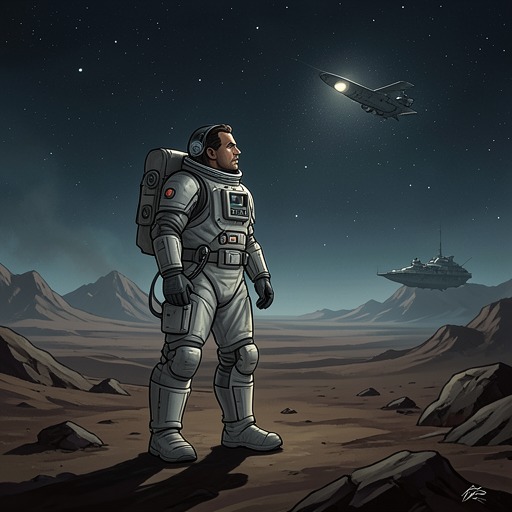
From the port side, the wall encloses a barren sixty-acre field with gantry cranes, a rocket pad, warehouses, a truck garage, and a grimy dormitory. The dormitory is a quarantine, and the boundary shuts in not only ships and visitors but the worlds they come from and the rest of the universe, leaving Anarres outside. Seen from the other side, however, the same wall encloses the whole planet. Anarres itself appears as a prison camp, isolated from other worlds and people. Neither reading cancels the other: the wall can stand for protection from the universe and for confinement within the settlement’s limits.
The port is the narrow, visible point where those meanings meet. People come from nearby Abbenay hoping to see a ship, although freighters arrive only eight times a year and their arrivals are not announced to the public. Spectators may sit on the wall and watch the work at the warehouses, but their access to the ships and the visitors remains limited. The rare freighter makes the boundary briefly vivid, while the routine separation remains in place.
Settlement, Trade, and Restricted Contact
The isolation followed the founding of the Anarresti settlement. For more than twenty years, twelve ships granted to the Odonian Settlers by the Council of World Governments carried the million people who chose the new life across the dry abyss. Once the transfer was complete, the port closed to immigration and remained open only to freight ships under the Trade Agreement. Anarres was therefore not simply beyond reach: the ongoing trade connection depended on a deliberately narrow channel, while ordinary migration and exchange between the worlds were shut down.
That arrangement also produced an uneven distribution of knowledge. Anarresti people were taught about Urras, but largely through accounts of Odo’s time and the history before it; after a century and a half since the Settlement, they had little information about contemporary Urrasti life. Tirin points out that old pictures cannot establish what Urras is like now, and that the people cannot know whether society there has changed. Bedap replies that the Production and Distribution Coordination network receives information through Urrasti freighter crews, partly to maintain trade and assess the threat Urras poses. But this knowledge is concentrated: as Tirin observes, the institution may be informed while the wider population is not.
Shevek’s arrival on Urras makes the consequences of that estrangement personal. He explains that he came to learn, because each society has become the other’s history and ignorance can produce further wrong. His appeal to mutual knowledge sits uneasily beside the political systems that regulate contact. Even ordinary material exchange exposes the distance between them: unable to bring money or enough supplies for himself, he describes himself as a beggar who must depend on Urrasti giving rather than buying. His presence thus tests whether the worlds can meet as people, rather than only as a sealed settlement and a trading partner.
The Boundary as Political Control
Isolation is maintained not only by the port wall but also by rules governing movement and information. During the declared war between A-Io and Thu, an Urrasti official describes renewed restrictions: research at the College of Noble Science can be classified, publication can be delayed, and non-nationals such as Shevek are not supposed to leave the campus without the Chancellor’s clearance. The restrictions are presented as wartime measures, even as the official treats evasion as a practical possibility. The episode contrasts the formal controls imposed by a state with the limited, rule-bound opening through which Shevek has entered Urras.
The Settlement’s closure terms make the asymmetry at Anarres’s own boundary explicit. Anyone may leave, Rulag says, if a freight ship will take them, but a person who departs cannot return. She cites the rule that no one may get off the freight ships beyond the boundary of the Port of Anarres. The restriction turns departure into a one-way crossing: the port is open enough to permit exit, but not to restore the connection for a returning Anarresti. The boundary is therefore not merely a line between worlds; it is a condition attached to belonging.
Isolation Under Pressure
The novel sets the port’s quiet separation against the violence of political life on Urras. In Capitol Square, police helicopters fire into a crowd, and the noise of their weapons and rotating blades overwhelms the demonstration. Shevek later helps an injured companion into a locked warehouse basement, breaking the hasp and padlock because every door is closed and property is private. These scenes show that crossing out of isolation does not mean entering a free or unified world. Urras has its own barriers, enforced through property, state authority, and violence.
The contrast also unsettles the idea that distance alone can preserve a society from the consequences of the wider world. When talk of drought turns to the possibility of another Great Drought, Desar invokes modern desalinization plants as prevention; Terrus answers that they might only alleviate the crisis. The exchange belongs to Anarres’s own struggle with scarcity, but it recalls the limits of treating separation as security. The wall can keep worlds apart, yet it cannot make Anarres self-sufficient or erase the pressures that shape life within it.
Meaning and Consequences
The novel repeatedly treats isolation as a spatial and political arrangement rather than a neutral fact of distance. Abbenay’s plain buildings, small tough windows, and limits on lighting and heating reflect an ethic of organic economy, while the port’s quarantine and restricted arrivals give that ethic a stark outer edge. Inside the settlement, goods and ideas are meant to circulate through decentralized networks; across the planetary boundary, circulation is narrowed to freight and regulated encounter. The juxtaposition makes the wall an exception within a society organized around sharing and interchange.
Isolation consequently has a double cost. It shields Anarres from direct political domination by Urras, but it also restricts ordinary people’s access to knowledge and makes sustained personal contact difficult. Shevek’s wish to learn from Urras challenges the assumption that separation can stand in for understanding; the restrictions on his movement and the permanent bar on return show how institutions can contain that opening. The wall’s lasting significance lies in this unresolved tension: it is at once a defense, a quarantine, and a prison boundary, and its meaning changes with the person who stands beside it.